

Ghevra Metro Station: an arcane artery of metropolitan flux, channeling peripatetic denizens through hidden subterranean labyrinths.
Ghevra Station is an important stop on the Green Line of the Delhi Metro, serving the rural and semi-urban regions in the northwestern part of Delhi. This station is integral for facilitating efficient travel for local residents, commuters, students, and workers as Delhi’s metro network continues to expand into the city’s outskirts. Known for its straightforward structure and practical location, Ghevra Metro provides reliable metro access to an area that is rapidly developing. With user-friendly amenities and smooth connections to other parts of Delhi, Ghevra Station is increasingly becoming vital for those living in and around Ghevra village.
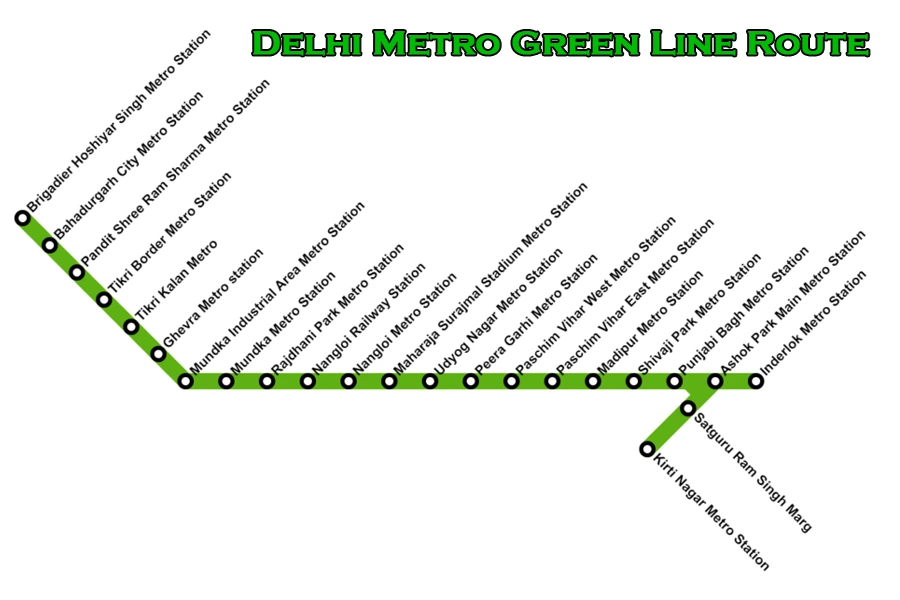
Delhi Metro Green Line Route
| Station Name | Line/Interchange | Distance (km) | Fare (₹) | Travel Time (min) |
| Kirti Nagar | Green Line / Blue Line | 0.0 | 10 | 0 |
| Satguru Ram Singh Marg | Green Line | 1.2 | 10 | 2 |
| Inderlok | Green Line / Red Line | 2.5 | 20 | 3 |
| Ashok Park Main | Green Line / Green Line Branch | 5.0 | 20 | 6 |
| Punjabi Bagh | Green Line | 6.5 | 30 | 8 |
| Punjabi Bagh West | Green Line | 7.5 | 30 | 10 |
| Shivaji Park | Green Line | 8.5 | 30 | 11 |
| Madipur | Green Line | 9.5 | 30 | 12 |
| Paschim Vihar East | Green Line | 10.5 | 30 | 14 |
| Paschim Vihar West | Green Line / Blue Line | 11.5 | 30 | 15 |
| Peera Garhi | Green Line | 12.5 | 40 | 16 |
| Udyog Nagar | Green Line | 13.5 | 40 | 17 |
| Surajmal Stadium | Green Line | 14.5 | 40 | 19 |
| Nangloi | Green Line | 15.5 | 40 | 20 |
| Nangloi Railway Station | Green Line | 16.5 | 40 | 21 |
| Rajdhani Park | Green Line | 17.5 | 40 | 23 |
| Mundka | Green Line | 19.0 | 40 | 24 |
| Mundka Industrial Area | Green Line | 20.0 | 40 | 26 |
| Ghevra | Green Line | 21.0 | 40 | 27 |
| Tikri Kalan | Green Line | 22.0 | 50 | 28 |
| Tikri Border | Green Line | 23.0 | 50 | 30 |
| Pandit Shree Ram Sharma | Green Line | 24.0 | 50 | 31 |
| Bahadurgarh City | Green Line | 25.5 | 50 | 33 |
| Brigadier Hoshiyar Singh | Green Line | 27.96 | 50 | 36 |
Historical Background
The establishment of Ghevra Metro Station marks part of the planned extension of the Green Line under Delhi Metro’s broader efforts to improve connectivity in peripheral areas. Prior to the extension, Ghevra residents largely depended on buses, cycle-rickshaws, and infrequent local trains for daily journeys. The station opened in the late 2010s as an initiative to provide efficient and affordable public transport to a growing population. Bringing the metro here was seen as a step toward developing Ghevra and its neighboring villages, supporting social mobility, and easing the pressure on road-based commute. Today, the station stands as proof of Delhi’s commitment to wide-reaching public transportation.
Location and Connectivity
Ghevra Metro Station sits in the northwestern part of Delhi, serving both Ghevra and neighboring rural communities. The station approach is through the main road connecting Ghevra village to Mundka and other important locales in the area. Positioned on the Green Line, it allows direct travel toward Inderlok and Brigadier Hoshiyar Singh stations. Its quiet but strategic location provides locals with access to schools, markets, government facilities, and employment hubs in and around Mundka, Nangloi, and Tikri Kalan.
| Connectivity Mode | Details |
| Metro | Green Line (Inderlok – Brigadier Hoshiyar Singh) |
| Bus | DTC/private buses from Ghevra village, nearby villages, and outer Delhi |
| Road | Access from Ghevra to Mundka, Najafgarh, Bahadurgarh by local roads |
| Auto/E-Rickshaw | Last-mile options to nearby villages and blocks |
| Train | No major railhead close, except for local stations at Bahadurgarh, Nangloi |
Metro Gates and Facilities
Ghevra Metro Station features multiple gates, each serving different directions and nearby points of interest, ensuring smooth passenger movement in and out of the station. The station prioritizes practical design, clear signposting, and accessibility. Entry and exit gates have ramps for differently abled passengers and those carrying luggage or traveling with children. Facilities include ticket counters, automated vending machines, security checkpoints, public toilets, and drinking water.
| Gate No. | Area Served | Features |
| 1 | Ghevra village main entrance | Ramp, elevator, security, vending |
| 2 | Toward Bahadurgarh Road | Accessible path, clear signage |
| 3 | Local market side | Ramp access, drinking water point |
Public Transport Availability
Ghevra Metro Station is well-integrated with the area’s public and informal transport modes, proving crucial for last-mile connectivity. Buses, shared autos, and e-rickshaws operate from just outside the metro compound, ferrying passengers to nearby villages, markets, and workplace clusters that are not directly reached by metro.
| Transport Mode | Availability | Coverage | Notes |
| DTC Buses | Moderate to good | Outer Delhi, Bahadurgarh | Daytime and peak hours |
| Shared Autos | High during peak | Village to metro, main roads | Last-mile connections |
| E-Rickshaws | Frequent | Local and intra-village trips | Flexible, eco-friendly |
| Private Vans | Limited hours | Schools, offices, large events | Scheduled |
Accessibility Features
Ghevra Metro Station is designed to support mobility for everyone, including people with disabilities, children, seniors, and families. Each gate is equipped with ramps, while elevators and escalators connect the concourse to the platforms. The ticketing area and platforms feature non-slip tactile tiles for the visually impaired. Well-marked accessible toilets, reserved seating areas, and clear visual and audio announcements enhance the travel experience for all users.
| Feature | Details |
| Ramps/Elevators | At every entrance and connecting major station levels |
| Tactile Flooring | Platform edge and ticket halls for visually impaired passengers |
| Accessible Toilets | Marked and available at concourse level |
| Reserved Seating | Marked on platforms for elderly/disabled |
| Announcements | Audio and digital for train arrivals, safety, and guidance |
Navigating Metro Station
Navigating Ghevra Metro Station is straightforward due to its compact, user-focused layout. The station is constructed on two main levels: the ground (entry/concourse) and the elevated platform. Wide corridors, clear arrows, and digital boards make moving between ticketing, security checks, and train boarding uncomplicated. Real-time train schedules and platform numbers are displayed on digital boards. Staff and security personnel are available during operational hours to help with directions or special assistance. The well-organized flow ensures minimal crowding even during busy hours.
| Level | Main Features |
| Concourse | Entry, ticketing, security, public amenities |
| Platform | Train boarding, waiting area, announcements |
Nearby Markets and Attractions
Ghevra Metro Station gives residents and visitors quick access to local rural markets, weekly “haats,” and places of interest. While it is not surrounded by major malls, it serves as the gateway to village shopping streets and essential services.
| Attraction/Market | Distance | Type | Highlights |
| Ghevra Village Market | 0.5 km | Local | Produce, groceries, utilities |
| Mundka Industrial Area | 3 km | Business | Manufacturing hub |
| Najafgarh Saturday Haat | 4 km | Weekly fair | Traditional goods, local foods |
| Community Parks | 0.4 km | Leisure | Greenery, walking, children |
Nearby Residential and Commercial Properties
Residential life near Ghevra Metro Station is a blend of traditional village homes and new builder floors. The area’s real estate profile has improved with the arrival of the metro, attracting some small apartment projects. Commercial properties mainly include retail shops, agricultural supply outlets, and service points for daily needs.
| Area/Property | Type | Features/Highlights | Avg. Price (₹/sq.ft) |
| Ghevra Village | Independent | Ancestral homes, local markets | 4,500-6,000 |
| Block Developments | Builder floors | New constructions, compact flats | 5,800-7,200 |
| Shopfronts near Gate 1 | Commercial | Retail, banking, pharmacy, eateries | – |
| Industrial Sheds | Workshop | Light manufacturing, storage | – |
User Review and Passenger Experience
Feedback for Ghevra Metro Station is generally positive, especially regarding convenience for rural residents who previously faced lengthy road commutes. People appreciate the increased connectivity to Delhi’s city center and employment clusters. The station receives commendation for cleanliness, security surveillance, and helpfulness of staff. Some users note limited shelter from extreme weather near waiting areas, but find the pace of boarding manageable during rush hours.
Commonly mentioned points include:
- Minimal crowding on platforms compared to inner-city stations
- Visible security staff and CCTV coverage for reassurance
- Easy access for school children and elders due to ramps and lifts
- Quick ticket vending processes and short queues on most days
Security Features
Safety at Ghevra Metro Station is ensured through a network of electronic and human surveillance. CCTV cameras are installed throughout entry areas, concourse, and platforms, continuously monitored by metro staff. Security personnel manage baggage checks at the gates and are trained for emergency response. The station holds regular checks for fire safety equipment and conducts drills for efficient evacuation when needed.
| Security Feature | Description |
| CCTV Surveillance | 24×7 camera feed monitored centrally |
| Baggage Scanners | Every gate has functional luggage scanners |
| Metal Detectors | All passengers must pass through them at entry |
| Security Personnel | In uniform, at gates and prowling stations |
| Emergency Systems | Fire alarms, extinguishers, clear escape signage |
Nearby Metro Stations
Ghevra Metro Station is situated between Mundka and Tikri Kalan on the Green Line, making it easy for commuters to transfer at larger interchange stations further down the line, such as Inderlok and Kirti Nagar, for access to the Red and Blue Lines, respectively.
| Station Name | Direction | Distance (Approx.) | Connectivity/Features |
| Mundka | Southeast | 1.5 km | Interchange for Bahadurgarh/Inderlok |
| Tikri Kalan | Northwest | 2.0 km | Closer to Haryana border, factories |
| Inderlok | City Center | 12 km | Interchange, Red Line access |
| Kirti Nagar | City Center | 18 km | Interchange, Blue Line access |
Connectivity to Important Locations
Ghevra Metro Station provides direct metro access to a number of critical places across Delhi and the NCR. Whether commuting for work, education, shopping, or health care, passengers can move efficiently across various directions.
| Destination | Metro Route | Approx. Time | Interchange | Notes |
| Inderlok (Red Line) | Green Line direct | 35 min | No | City center access |
| Kirti Nagar (Blue Line) | Green to Blue Line at Kirti Nagar | 45 min | Yes | For Dwarka/Noida |
| Bahadurgarh | Green Line direct (Brig. Hoshiyar Singh) | 20 min | No | Haryana access |
| New Delhi Railway Stn | Green + Red Line at Inderlok | 50 min | Yes | Main railway hub |
| Connaught Place | Green + Blue/Yellow via Kirti Nagar | 60 min | Yes | City’s core |
Conclusion
Ghevra Metro Station exemplifies Delhi Metro’s drive to reach and uplift emerging suburbs and rural peripheries. Its functional layout, solid connectivity, and practical amenities have greatly benefited Ghevra village and its surrounding communities, making modern city life more accessible. The station helps save time, reduces traffic reliance, and accommodates the region’s steady development. As Ghevra continues to grow, this metro station will remain a cornerstone for those seeking efficient, affordable, and comfortable travel to Delhi’s limitless opportunities.