Mundka Metro Station (DMRC): Get the latest 2025 route map, metro timings, station distance, and travel tips for daily commuters.
Introduction
Mundka Metro Station is an elevated station on the Green Line of the Delhi Metro, serving the Mundka village and surrounding industrial and semi-urban belts in outer West Delhi. In 2025, it continues to function as a key node connecting Delhi to the Bahadurgarh side of Haryana, with improved loop-based operations and strong integration with nearby industrial areas, affordable residential pockets, and growing commercial activity.
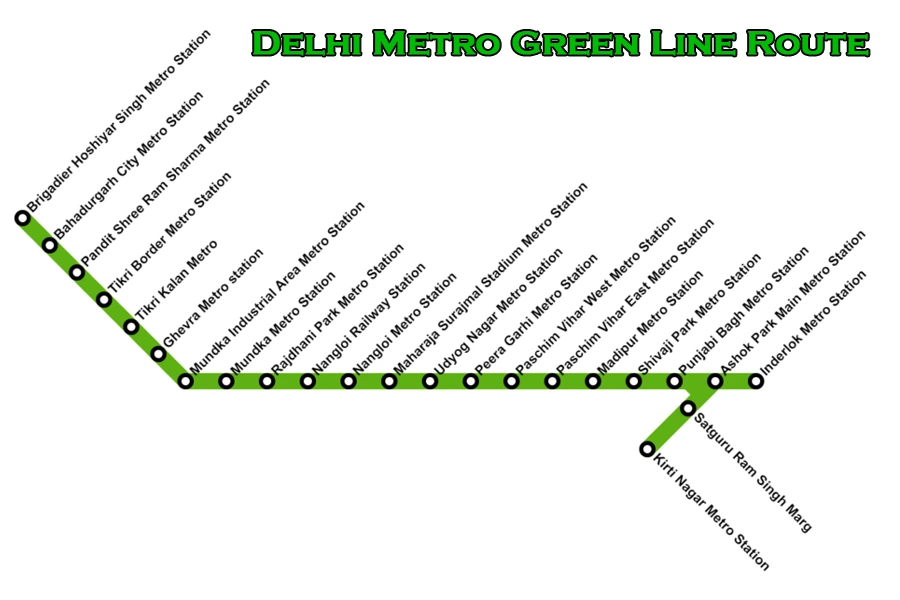
Delhi Metro Green Line Route 2025
Download Updated Delhi Metro Map 2025 – Click Here
| Station Name | Line/Interchange | Distance (km) | Fare (₹) | Travel Time (min) |
| Kirti Nagar | Green Line / Blue Line | 0.0 | 10 | 0 |
| Satguru Ram Singh Marg | Green Line | 1.2 | 10 | 2 |
| Inderlok | Green Line / Red Line | 2.5 | 20 | 3 |
| Ashok Park Main | Green Line / Green Line Branch | 5.0 | 20 | 6 |
| Punjabi Bagh | Green Line | 6.5 | 30 | 8 |
| Punjabi Bagh West | Green Line | 7.5 | 30 | 10 |
| Shivaji Park | Green Line | 8.5 | 30 | 11 |
| Madipur | Green Line | 9.5 | 30 | 12 |
| Paschim Vihar East | Green Line | 10.5 | 30 | 14 |
| Paschim Vihar West | Green Line / Blue Line | 11.5 | 30 | 15 |
| Peera Garhi | Green Line | 12.5 | 40 | 16 |
| Udyog Nagar | Green Line | 13.5 | 40 | 17 |
| Surajmal Stadium | Green Line | 14.5 | 40 | 19 |
| Nangloi | Green Line | 15.5 | 40 | 20 |
| Nangloi Railway Station | Green Line | 16.5 | 40 | 21 |
| Rajdhani Park | Green Line | 17.5 | 40 | 23 |
| Mundka | Green Line | 19.0 | 40 | 24 |
| Mundka Industrial Area | Green Line | 20.0 | 40 | 26 |
| Ghevra | Green Line | 21.0 | 40 | 27 |
| Tikri Kalan | Green Line | 22.0 | 50 | 28 |
| Tikri Border | Green Line | 23.0 | 50 | 30 |
| Pandit Shree Ram Sharma | Green Line | 24.0 | 50 | 31 |
| Bahadurgarh City | Green Line | 25.5 | 50 | 33 |
| Brigadier Hoshiyar Singh | Green Line | 27.96 | 50 | 36 |
Introduction
Mundka Metro Station lies on the Green Line (Line 5) of the Delhi Metro and primarily serves the Mundka village, adjoining industrial clusters, and developing residential neighborhoods in North West and West Delhi. The station was originally the western terminal of the Inderlok–Mundka section and remains one of the oldest Green Line stations, opened in April 2010 as part of the first phase of the line. Over the years, Mundka has transformed from a peripheral rural belt into a mixed-use corridor, with the metro station acting as a catalyst for industrial, warehousing, and low-to-mid budget housing growth. In 2025, Mundka Metro Station continues to be a preferred boarding and alighting point for daily commuters, factory workers, small business owners, and long-distance travelers using the Rohtak Road (NH-9) corridor.
Historical Background
The Green Line section from Inderlok to Mundka was inaugurated on 3 April 2010, bringing metro connectivity for the first time to large parts of West Delhi along the Delhi–Rohtak corridor. Mundka Metro Station was the terminal station on this line until the extension towards Bahadurgarh was commissioned, after which the line was further extended beyond Mundka up to Brigadier Hoshiar Singh, with intermediate stops like Mundka Industrial Area, Ghevra, Tikri Kalan, Tikri Border and stations in Bahadurgarh. This extension, approved in 2012 and opened later, helped integrate Haryana’s Bahadurgarh region with the Delhi Metro network, making Mundka a mid-line station rather than a terminal. Historically, Mundka village was largely agrarian, but grew into an industrial and warehousing hub after the development of Mundka Industrial Area and improved road connectivity along NH-9, which in turn boosted ridership and land values around the station.
Location and Connectivity
Mundka Metro Station is located along the Bahadurgarh Rohtak Road (NH-9) in the Mundka locality of West/North West Delhi, approximately 22 km from Connaught Place and about 10 km from Bahadurgarh in Haryana. The station’s coordinates are around 28.6824°N, 77.0306°E, placing it strategically between dense industrial belts, village settlements, and developing residential colonies. It connects directly to other Green Line stations such as Rajdhani Park to its east and Mundka Industrial Area to its west, forming part of the larger Kirti Nagar/Inderlok–Brigadier Hoshiar Singh alignment. Road connectivity is strong due to NH-9, with regular DTC and cluster buses, shared autos, private cabs, and local tempos available outside the station, ensuring last-mile connections to nearby colonies like Mundka village, Bakkarwala, and parts of the Mundka Industrial Area.
Quick Connectivity Snapshot
| Aspect | Details |
| Metro Line | Green Line (Line 5), Delhi Metro |
| Adjacent Stations | Rajdhani Park (towards Inderlok/Kirti Nagar), Mundka Industrial Area |
| Road Corridor | Bahadurgarh Rohtak Road (NH-9) |
| Approx. Distance to CP | About 22 km via road |
| Approx. Distance to Bahadurgarh | About 10 km via road |
General Information
Mundka Metro Station is an elevated station with standard Delhi Metro architecture, featuring side platforms and a concourse level above the road. Mundka Metro Station serves both local and regional commuters heading towards industrial clusters, residential pockets, and the extended Green Line corridor into Haryana. As of 2025, the Green Line operates in two fixed loops—Brigadier Hoshiar Singh to Kirti Nagar and Mundka to Inderlok on weekdays—allowing Mundka to function as an important intermediate node in the loop-based operations. The station is equipped with facilities such as escalators, lifts, toilets, first-aid room, and parking for two- and four-wheelers, making it suitable for regular commuters and park-and-ride users. Passenger information displays, announcements, and signage are available in English and Hindi, streamlining navigation for both local and outstation travelers.
Construction and Design
Mundka Metro Station is built as an elevated structure with piers and viaducts running along the central verge of Bahadurgarh Rohtak Road. The design follows DMRC’s standard elevated station template with two main passenger levels—concourse and platform—supported by reinforced concrete columns, ensuring durability and structural safety. The platforms are covered with a roof that offers weather protection while allowing natural light and ventilation, an important aspect in the semi-industrial, dust-prone surroundings of Mundka. Lifts and escalators connect street level, concourse, and platforms, with Divyang-friendly access designed according to DMRC accessibility norms and reflected in the station’s designation as Divyang-friendly. The construction of the original Inderlok–Mundka section reduced travel time drastically for residents of West Delhi and facilitated subsequent Green Line extension works towards Bahadurgarh.
Station Layout
Mundka Metro Station features elevated side platforms with a central concourse level housing ticketing, AFC (Automatic Fare Collection) gates, customer care, and basic amenities. Typically, one platform handles trains towards Inderlok and Kirti Nagar, while the other handles services towards Brigadier Hoshiar Singh via Mundka Industrial Area and stations in Delhi and Bahadurgarh. Clear directional signage and route maps on the concourse help passengers identify the correct platform for their desired direction, especially important after the Green Line’s operational restructuring into fixed loops in 2025. Staircases, escalators, and lifts provide multiple vertical circulation options between street level, concourse, and platforms, reducing congestion during peak hours.
Indicative Station Layout Table
| Level | Facilities and Areas |
| Street Level | Entry/exit gates, parking, feeder and bus stops, auto stands |
| Concourse Level | Ticket counters, TVMs, AFC gates, customer care, toilets |
| Platform Level | Two side platforms, seating, PIDS displays, CCTV, PA systems |
Entry/Exit Gates and Facilities
Mundka Metro Station generally has at least two designated entry/exit gates oriented towards major directions along Bahadurgarh Rohtak Road and the parking area. One gate opens towards the Bahadurgarh Rohtak Road side, which is useful for passengers coming from the main highway, local bus stops, and nearby roadside commerce, while another gate serves the DMRC-authorised parking and local access routes, including link roads into Mundka village. DMRC’s Divyangjan documentation lists lifts located near specific gates, facilitating barrier-free access from the street to the concourse and platform levels for wheelchair users and passengers with reduced mobility. Key on-station facilities include escalators, multiple lifts, Sulabh or similar toilets, a first-aid room, basic seating, security cabins, and CCTV-monitored areas, meeting standard DMRC service-level benchmarks.
Mundka Metro Station Entry/Exit Overview
| Gate No. | Oriented Towards | Typical Use Case |
| Gate 1 | Bahadurgarh Rohtak Road | Access to main road, buses, local shops |
| Gate 2 | Metro parking / local access roads | Park-and-ride users, residential access |
Public Transport Availability
Public transport availability around Mundka Metro Station is strong due to its placement on NH-9 and its role as a fringe-city connector. Delhi Transport Corporation (DTC) and cluster buses frequently ply along Bahadurgarh Rohtak Road, linking Mundka to areas like Nangloi, Punjabi Bagh, Peeragarhi, and central Delhi, as well as routes towards Bahadurgarh. Shared auto-rickshaws, Gramin Sewa vehicles, e‑rickshaws, and local tempos operate from near the station exits, offering last-mile connectivity to Mundka village, Mundka Industrial Area, Bakkarwala, Rani Khera, and adjacent colonies. On-demand cabs and bike taxis via app-based services are commonly used by commuters heading deeper into industrial pockets and warehouse clusters that may not be on formal bus routes. For many factory workers and daily wage earners, the combination of Green Line metro services and local shared transport provides an affordable and time-efficient commute pattern.
Accessibility Features
Mundka Metro Station is listed as a Divyang-friendly station on the Green Line, aligning with DMRC’s broader commitment to accessible public transport. Lifts are positioned strategically near entry/exit points and within the concourse to ensure that wheelchair users and passengers with limited mobility can reach platforms without barriers. Tactile pathways are typically provided from gate areas to key functional points like ticketing zones, AFC gates, and platform edges to aid visually impaired passengers. Audio-visual announcements on trains and platforms help those with hearing or visual limitations stay informed about train arrivals, departures, and safety instructions. Standard features like reserved seating, ramped entries where necessary, and clear signage in multiple languages further enhance accessibility for elderly passengers, pregnant women, and people traveling with luggage or children.
Navigating Mundka Metro Station
Navigating Mundka Metro Station is straightforward thanks to its linear layout and clear directional signage. On arrival at street level, passengers can use the nearest gate based on whether they are coming from NH-9, local colonies, or the parking area, then follow signboards leading to the concourse. At the concourse, passengers purchase tokens or recharge smart cards at ticket counters or Ticket Vending Machines, then proceed through AFC gates to stairs, lifts, or escalators leading to the appropriate platform (Inderlok/Kirti Nagar direction or Brigadier Hoshiar Singh direction). Platform display boards show the destination and expected arrival of the next trains, which is particularly useful in the 2025 loop-based operation model where some trains operate Mundka–Inderlok and others Brigadier Hoshiar Singh–Kirti Nagar. For first-time users and outstation commuters, route maps and line diagrams placed at multiple points help in planning interchanges with the Red and Blue Lines through Green Line connections.
Nearby Markets and Attractions
Mundka’s surroundings are predominantly industrial and semi-urban, but they also feature local markets, parks, and temples that cater to residents and workers. Local bazaars and roadside markets along Bahadurgarh Rohtak Road offer daily essentials, hardware, food outlets, and services aimed at workers from nearby factories and warehouses. Within Mundka and Mundka Industrial Area, small eateries, dhabas, and tea stalls are common, serving industrial workforce and travelers using the highway and metro. Cultural and religious landmarks in the wider Mundka region, including local temples and community parks like Victory Sports Park, add to the neighborhood’s social fabric and are accessible via short rides from the station.
Nearby Markets and Points of Interest
| Place / Area | Approx. Distance from Station | Primary Intent / Use |
| Local Mundka Bazaar | 0.5–1 km | Daily shopping, food, services |
| Roadside NH-9 market | 0.2–0.8 km | Transit food, hardware, auto spares |
| Victory Sports Park | Around Mundka area | Recreation, sports for residents |
| Mundka village core | 0.5–1.5 km | Residential, local shops, temples |
Nearby Residential and Commercial Properties
Mundka and Mundka Industrial Area are known for their mix of affordable housing, plotted developments, and extensive industrial and warehousing facilities. The locality attracts buyers and tenants looking for budget-friendly plots and builder floors, particularly those employed in nearby industrial units and logistics parks. Key neighboring zones include Mundka village, Mundka Industrial Area, Bakkarwala, Rani Khera, and extended precincts along NH-9 and towards Bahadurgarh, with property rates that are typically lower than inner-city West Delhi areas like Paschim Vihar. Commercially, the region is dominated by factories, warehouses, and small-to-medium enterprises in sectors such as manufacturing, logistics, packaging, and trading, taking advantage of both road and metro connectivity.
Sample Nearby Residential and Commercial Clusters
| Locality / Cluster | Nature | Approx. Relation to Station |
| Mundka village | Residential/semi-urban | Immediate catchment area |
| Mundka Industrial Area | Industrial/commercial | Next station and surrounding belt |
| Bakkarwala / DDA flats belt | Residential | Short drive via local roads |
| Rani Khera area | Semi-urban/residential | Within broader Mundka influence zone |
User Reviews and Passenger Experience
User feedback on Mundka and the broader Mundka locality is generally positive regarding connectivity and affordability, but mixed on environmental and traffic conditions. Residents and regular commuters appreciate the Green Line connection, which provides direct, predictable travel into Delhi and towards Bahadurgarh, reducing reliance on buses and personal vehicles and improving commute reliability. Reviews highlight Mundka’s affordable housing and proximity to schools, bus stops, and the metro station as strong advantages, especially for working families and industrial workers. On the downside, users often mention dust, noise pollution, and congestion along NH-9, particularly around peak hours and truck movement times, which can affect the immediate environment outside the station. Nonetheless, for many travelers, Mundka Metro Station offers a functional, cost-effective gateway to the city, balancing minor drawbacks with significant mobility benefits.
Security Features
Security at Mundka Metro Station follows DMRC’s standard protocol, with CISF or designated security personnel managing entry points and station surveillance. All passengers and baggage are screened through metal detectors and X-ray scanners at entry/exit gates, supported by frisking and random checks during sensitive periods. CCTV cameras are installed across concourse and platform levels, as well as key points like AFC zones, lift lobbies, and staircases, providing real-time monitoring to the station control room. Public address systems and display boards are used not only for operational announcements but also for safety advisories and emergency communication. Fire-safety equipment, emergency exits, and clearly marked evacuation routes form part of the station’s design, helping ensure safe operations even during high footfall or service disruptions.
Nearby Metro Stations
Mundka is located towards the western side of the Green Line between Rajdhani Park and Mundka Industrial Area, forming part of the stretch that eventually extends to Brigadier Hoshiar Singh in Bahadurgarh. To the east, Rajdhani Park connects Mundka with more urbanized West Delhi localities and further interchange options via the Green Line’s link with Red and Blue Lines. To the west, Mundka Industrial Area Metro Station directly serves the industrial zone, followed by Ghevra, Tikri Kalan, Tikri Border and onward stations towards Haryana. This cluster of stations ensures that both residential colonies and industrial pockets along NH-9 are within short travel distance of a metro stop, bolstering regional connectivity.
Neighboring Metro Stations on Green Line
| Direction | Next Station | Notes |
| Towards Delhi | Rajdhani Park | Links onwards to Punjabi Bagh/Paschim Vihar |
| Towards Haryana | Mundka Industrial Area | Serves Mundka Industrial Area and DDA flats |
| Further towards Haryana | Ghevra, Tikri Kalan, Tikri Border, etc. | Part of Bahadurgarh extension |
Connectivity to Important Locations
Using Mundka Metro Station, passengers can reach several key areas across Delhi and NCR via the Green Line and its interchanges. By staying on the Green Line towards Inderlok or Kirti Nagar, riders can interchange with the Red Line at Inderlok and the Blue Line at Kirti Nagar, gaining access to hubs like Connaught Place, Karol Bagh, Rajiv Chowk, Noida, and Dwarka through connecting lines. For commuters heading to Bahadurgarh and adjacent industrial zones, Mundka acts as a mid-point, offering flexible boarding options along the line while still being close to Haryana’s border. Road connectivity via NH-9 further supports travel by bus or car to outer Delhi, Bahadurgarh, and other parts of Haryana, making Mundka a dual-mode gateway for both metro and highway users.
Example Connectivity Matrix (Indicative)
| Destination Area | Typical Route from Mundka Metro Station |
| Inderlok | Green Line towards Inderlok |
| Kirti Nagar | Green Line towards Kirti Nagar |
| Connaught Place (Rajiv Chowk) | Green Line to Kirti Nagar → Blue Line to Rajiv Chowk |
| Bahadurgarh (City Park/Brig. Hoshiar Singh) | Green Line towards Brigadier Hoshiar Singh |
| Paschim Vihar / Nangloi | Green Line towards Inderlok via intermediate stations |
2025 Updates and Recent Changes
In 2025, a major operational update on the Green Line introduced fixed loops: trains now operate in two distinct patterns—Brigadier Hoshiar Singh to Kirti Nagar and Mundka to Inderlok on weekdays. This change aims to enhance service reliability and manage passenger loads more efficiently, with Mundka acting as a turning point for the loop connecting to Inderlok, thereby increasing its strategic importance for commuters from outer West Delhi. Parallel planning for further Green Line integration under Phase 4, including the Inderlok–Indraprastha connection, promises better network connectivity in coming years and is expected to directly benefit Mundka riders by offering more seamless interchanges with other lines. On the real estate side, reports in 2025 show Mundka continuing to develop with new industrial, logistics, and budget housing projects fueled by metro proximity, although environmental concerns like dust and traffic congestion remain challenges for local authorities.
Conclusion
Mundka Metro Station is a crucial elevated stop on the Green Line that anchors the mobility needs of outer West Delhi, Mundka village, and the surrounding industrial corridors. Its evolution from a terminal station to a mid-line connector on an extended corridor to Bahadurgarh, coupled with the 2025 loop-based operating pattern, has reinforced its status as a strategic transit node for both Delhi and Haryana commuters. With Divyang-friendly features, essential facilities, integrated public transport, and proximity to affordable housing and industrial employment centers, Mundka Metro Station offers a practical balance of accessibility, cost-efficiency, and connectivity for daily passengers. As further network expansions and local developments unfold, the station is likely to remain a key gateway for workers, residents, and travelers moving along the Delhi–Rohtak–Bahadurgarh axis.