Nangli Metro Station (DMRC), Check first and last train timings, updated 2026 route map, stations list, and travel tips.
Nangli Metro Station is an elevated station on the Grey Line of the Delhi Metro, serving the Najafgarh–Dwarka corridor and key colonies like Nangli Sakrawati, Nangli Dairy, Ranaji Enclave and Masudabad in South West Delhi. Opened in October 2019, it has quickly become a crucial connector between dense residential pockets, small industries and the wider Delhi Metro network via Dwarka, with steady ridership growth and improved multimodal access in 2025.
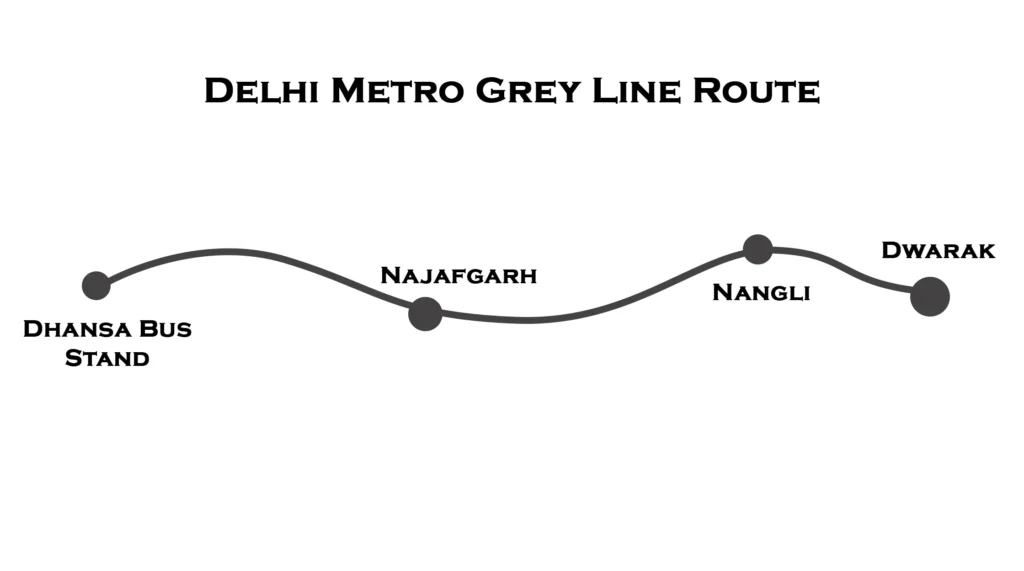
Delhi Metro Grey Line Route
Download DMRC Route Map PDF – Click Here
| Station No. | Station Name | Line | Distance from Dwarka (approx.) | Travel Time from Dwarka | Typical Fare* |
| 1 | Dwarka Metro Station | Grey | 0 km | 0 min | ₹10 (0-2 km) |
| 2 | Nangli Metro Station | Grey | ~2.0–2.5 km | ~3 min | ₹10–20 |
| 3 | Najafgarh Metro Station | Grey | ~4.0–4.5 km | ~6 min | ₹20 |
| 4 | Dhansa Bus Stand Metro Station | Grey | ~5.19 km | ~8 min | ₹30 |
Introduction
Nangli Metro Station is a relatively new but strategically located stop on the Grey Line, linking the Dhansa Bus Stand–Najafgarh belt with Dwarka and onward interchange to the Blue Line. Situated near Ranaji Enclave and Masudabad, it offers daily commuters, students and workers a faster alternative to congested Najafgarh Road and local bus routes. The station features a simple elevated design with side platforms, basic amenities and Divyang-friendly infrastructure that aligns with Delhi Metro’s overall standards of safety, punctuality and cleanliness.
In 2025, Nangli Metro Station continues to expand its role as a local transport hub, with better bus integration, growing nearby housing supply and more awareness among passengers using long tail searches like Nangli metro station nearest bus stop and Nangli metro station route to Dwarka.
Historical background
Nangli Metro Station was developed under Phase III expansion of the Delhi Metro, designed to push rapid transit deeper into the Najafgarh region, which historically depended on buses and shared transport. The station opened to the public on 4 October 2019 along the Grey Line section connecting Dwarka with Najafgarh, and later extended further to Dhansa Bus Stand, strengthening the corridor’s reach. Before the metro’s arrival, surrounding colonies like Nangli Sakrawati and Nangli Dairy relied on narrow roads and mixed-traffic corridors, which made commuting slow and unreliable, particularly during peak hours.
With the operationalization of Nangli Metro Station, residents gained a reliable, high-frequency rail option that significantly cut travel time to Dwarka, central Delhi and other employment hubs connected via the Blue Line. In 2025, the station’s history is increasingly tied to the broader development of Najafgarh as a better connected suburban node within Delhi NCR.
Location and connectivity
Nangli Metro Station is located at Ranaji Enclave, Masudabad, Najafgarh, Delhi 110043, close to Nangli Sakrawati and other dense residential clusters. Positioned on the Grey Line between Najafgarh and Dwarka, it provides direct metro connectivity toward Dhansa Bus Stand in the west and Dwarka in the east, where passengers can interchange to the Blue Line at Dwarka.
The station lies near important localities such as Nangli Sakrawati, Nangli Dairy, Nangli Vihar, Arjun Park, Jemini Park and Indra Park, all benefiting from improved access to central and western Delhi. Road connectivity from the station is supported by local roads linking Ranaji Enclave, Sainik Enclave and Najafgarh town, while buses and shared autos extend last-mile connectivity to nearby markets, schools, small industrial areas and religious spots like the Najafgarh Sai Baba Mandir.
General information
Nangli Metro Station is an elevated station on the Grey Line with side platforms, designed primarily for suburban commuter flows between Najafgarh and Dwarka. It is fully functional and active, with a standard DMRC layout including concourse level with ticket counters, customer care, AFC gates and security checks, and a street level for entry and exit to adjoining neighborhoods.
The station does not currently offer dedicated parking or feeder bus services, which shifts the focus toward walking, e-rickshaws, auto-rickshaws and local buses for first and last mile connectivity. In 2025, Nangli Metro Station continues operating with typical Delhi Metro service standards, including punctual trains, security checks and basic amenities that attract regular passengers, even though it functions more as a local access station than a major interchange hub.
Construction and design
As part of Phase III of Delhi Metro, Nangli Metro Station was constructed as an elevated structure to adapt to the existing built-up surroundings and minimize land acquisition in the Najafgarh–Ranaji Enclave belt. The station uses a standard viaduct and platform design seen on several outer-corridor stations, with concrete piers supporting the elevated track and platforms above the road level. The layout includes a concourse level below the platforms housing ticketing, security, control rooms and passenger circulation areas, with stairs, escalators and lifts connecting all levels.
Design features reflect practical considerations: side platforms instead of island platforms for easier construction, clear signage in Hindi and English, weather-protecting canopies and safety elements like tactile tiles for visually impaired commuters. In 2025, no large structural alterations are reported, but minor upgrades like better lighting, refreshed signages and improved crowd circulation paths are gradually implemented in line with DMRC standards.
Station layout
Nangli Metro Station follows a three-level layout: street level at the base, concourse level in the middle and platform level at the top. The street level provides entrances and exits opening toward nearby colonies such as Nangli Sakrawati, Ranaji Enclave and Sainik Enclave, linking directly to local roads and auto stands. On the concourse level (L1), passengers find fare control, ticket counters, smart card vending machines, security screening and the crossover needed to change between the platforms.
The platform level (L2) consists of two side platforms where doors open on the left, with Platform 1 typically serving westbound trains towards Dhansa Bus Stand via Najafgarh and Platform 2 serving eastbound trains towards Dwarka, from where commuters can switch to the Blue Line. Clear route maps, information boards and public address systems help passengers navigate the station effectively, even during peak hours.
Nangli Metro Station layout overview
| Level | Description | Key facilities | Directions |
| Street level | Ground access to station | Entry/exit points, auto/e-rickshaw pickup zones | Access to Nangli Sakrawati, Ranaji Enclave, nearby roads |
| Concourse (L1) | Ticketing and control area | Ticket counters, AFC gates, security, customer care | Crossover between platforms, access to lifts/escalators |
| Platform (L2) | Two side platforms | Waiting areas, route maps, safety markings | Platform 1: towards Dhansa Bus Stand; Platform 2: towards Dwarka |
Entry/exit gates and facilities
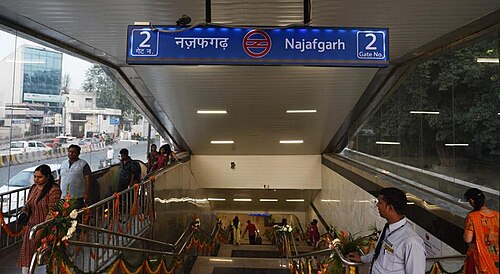
Nangli Metro Station has multiple entry/exit gates to serve different neighborhoods, notably Gate 1 and Gate 2 that open toward distinct residential clusters. Gate 1 connects primarily toward Anand Vihar side of the local area, including Nangli Sakrawati, Arjun Park and adjacent pockets, making it convenient for residents in these localities. Gate 2 opens toward Sainik Enclave and Ranaji Enclave side, catering to passengers from nearby housing and mixed-use lanes in that direction.
At the concourse and gate areas, passengers typically find essential facilities like ticket counters, CCTV-supervised security checks, basic seating, drinking water points, Sulabh toilets and at least one ATM, along with signages showing directions toward buses and shared modes. The gates are designed to be Divyang-friendly, with ramps or lifts facilitating access for wheelchairs and elderly passengers from street level to the concourse and platforms.
Public transport availability
Nangli Metro Station is supported by a web of DTC and cluster buses, along with private mini buses and shared autos that connect to different parts of Najafgarh and surrounding areas. Buses like DTC routes 764, 817, 835 and similar services operate in the wider Najafgarh–Dwarka corridor, allowing passengers to transfer between bus stops and the station for extended connectivity beyond the metro alignment. Local e-rickshaws, auto-rickshaws and Gramin Sewa vehicles provide last-mile connections to nearby colonies such as Nangli Sakrawati, Nangli Dairy, Nangli Vihar, Arjun Park and industrial pockets like Nangli Sakrawati small industry area.
Although the station does not have an official feeder bus hub or formal parking, the combination of on-road bus stops, auto stands and shared modes ensures that passengers can move to and from the station efficiently at most hours of the day. In 2025, this multi-modal integration supports search interests like Nangli metro station bus routes, Nangli metro station nearest bus stand and Nangli metro to Najafgarh bus.
Accessibility features
Nangli Metro Station incorporates accessibility features consistent with DMRC’s Divyang-friendly standards, making it easier for people with reduced mobility to use the facility. The station offers lifts and escalators that connect street level, concourse and platform levels, reducing dependence on stairs and improving comfort for elderly passengers, children and those carrying luggage.
Tactile paths and warning strips along the platform edges assist visually impaired riders in navigating safely, while audio announcements in Hindi and English keep all passengers informed about arriving trains, route changes and safety messages. The presence of Sulabh toilets and accessible restrooms further supports extended use of the station by diverse passenger groups, including women, families and differently-abled commuters. In 2025, accessibility remains a core feature, and Nangli Metro Station is often highlighted in information portals as Divyang-friendly, aligning with broader efforts to make the Delhi Metro inclusive.
First and last train timings
For regular commuters, first and last train timings from Nangli Metro Station are critical for planning daily travel, especially for early morning and late-night journeys. Towards Dwarka, the first metro from Nangli typically departs around 06:06 in the morning, with the last train scheduled close to 23:05 at night, giving a broad operational window for office-goers and shift workers. In the opposite direction, towards Dhansa Bus Stand via Najafgarh, the first train usually leaves around 06:03 and the last train near 23:02, ensuring that passengers in the Najafgarh–Dhansa belt can also rely on early and late services.
Train frequency is tighter during peak hours, with intervals around 7–8 minutes on weekdays, while non-peak and Sunday services run at slightly longer headways, aligning with typical Grey Line operations. These timings are subject to occasional changes due to maintenance or special events, so commuters are encouraged to verify updated schedules through official metro apps or station announcements in 2025.
First and last train table – Nangli Metro Station
| Direction | First train (approx.) | Last train (approx.) | Typical peak frequency | Typical non-peak frequency |
| Towards Dwarka | 06:06 | 23:05 | About every 7.5 minutes Monday–Saturday | About every 12 minutes on weekdays and Sundays |
| Towards Dhansa Bus Stand | 06:03 | 23:02 | About every 7.5 minutes Monday–Saturday | About every 12 minutes on weekdays and Sundays |
Navigating Nangli Metro Station
Navigating Nangli Metro Station is relatively straightforward due to its compact, linear design and standard DMRC wayfinding system. On entering from Gate 1 or Gate 2, passengers pass through security screening and then move to the concourse area, where clear signs direct them to ticket counters, customer care and platforms. For travel towards Dwarka and the Blue Line interchange, commuters follow signs to the eastbound platform, while those heading to Najafgarh and Dhansa Bus Stand move to the westbound platform.
The platforms display route maps, electronic signboards and audio announcements indicating train direction, expected arrival time and terminal station, which simplifies choices even for first-time users searching online for terms like how to reach Nangli metro station from Dwarka or Nangli metro to Najafgarh route. During peak hours, standing zones near doors, marked queuing lines and security personnel help manage boarding and alighting efficiently.
Nearby markets and attractions
Nangli Metro Station sits within a largely residential and semi-industrial pocket, but there are several local markets, commercial streets and attractions within a short distance. Nearby colonies like Nangli Sakrawati, Nangli Dairy, Nangli Vihar, Arjun Park and Indra Park host local bazaars, daily-need shops, small eateries and service outlets that residents typically use after getting off at the station.
Najafgarh town, reachable by short bus or auto rides, offers bigger markets, clothing stores, electronics retailers, banks and restaurants, making it a frequent destination for shoppers using the metro. Religious and cultural sites, including Najafgarh Sai Baba Mandir located about 500 meters from the station, attract regular visitors and devotees who prefer the metro for convenience and reliability. In 2025, local business activity near the station continues to expand, with more small shops and real estate offices focusing on commuters looking for Nangli metro station nearby market or shops near Nangli metro.
Nearby residential and commercial properties
The catchment area of Nangli Metro Station covers a mix of traditional villages, unauthorized colonies and plotted residential developments, which now benefit from better public transport. Localities such as Nangli Sakrawati, Nangli Dairy, Nangli Vihar, Arjun Park, Jemini Park and Ranaji Enclave provide primarily low-rise housing, independent floors and small apartments that appeal to families and working-class residents who commute via the Grey Line.
The presence of the station has increased the attractiveness of these pockets for tenants, leading to moderate rental appreciation and more interest in phrases like flats near Nangli metro station or 2 BHK near Nangli metro in property listings. Small industries and workshops in Nangli Sakrawati’s industrial area, along with local shops and coaching centers, form the key commercial fabric nearby, drawing both workers and customers via the metro. In 2025, affordable housing remains the main draw of the area, supported by easy metro access and potential for further urban development along the Najafgarh–Dwarka corridor.
Sample property and locality snapshot near Nangli Metro Station
| Locality/cluster | Approximate distance from station | Main property type | Key characteristics |
| Nangli Sakrawati | Within 0–1 km | Low-rise houses, plots, small apartments | Dense, affordable, mixed residential and small industrial use |
| Ranaji Enclave | Walking distance | Independent floors and builder floors | Popular with families, close to station and local markets |
| Nangli Dairy / Nangli Vihar | Around 1–2 km | Houses and compact apartments | Budget-friendly, reliant on autos/e-rickshaws to reach metro |
User review and passenger experience
User feedback about Nangli Metro Station typically highlights its convenience for residents of nearby colonies, reliable train services and clean station environment, similar to most Grey Line facilities. Passengers appreciate the reduction in travel time to Dwarka and the Blue Line, which previously required long bus rides or multiple changes, especially for office commuters and students.
The absence of formal parking and feeder bus services is sometimes noted as a limitation, pushing commuters to depend on shared autos, rickshaws and informal arrangements for last-mile connectivity. However, overall sentiment remains positive due to affordable fares, regular trains, Divyang-friendly features and the station’s proximity to homes and small businesses, making it a preferred choice for daily travel in 2025. User-generated content and local property ads also frequently mention the station as a prime locational advantage, reinforcing its importance in the area.
Security features
Nangli Metro Station follows standard DMRC security protocols, ensuring a safe environment for commuters at all operating hours. All passengers entering the station pass through baggage scanners and metal detectors, while CISF personnel or authorized security staff monitor entries, platforms and concourse areas. CCTV cameras cover critical zones such as ticketing counters, AFC gates, corridors, staircases and platforms, allowing real-time monitoring and quick response to incidents or suspicious activity.
Public address systems and digital signboards help manage crowds, especially during peak hours, and assist in disseminating safety advisories or emergency instructions. Emergency equipment like fire extinguishers, alarm switches and clear evacuation signage also contribute to overall safety preparedness. As of 2025, Nangli Metro Station continues to operate under these established protocols, contributing to the perception of the Delhi Metro as a secure mode of transport, particularly for women and late-evening commuters.
Nearby metro stations
Nangli is one of the stations on the Grey Line, positioned between Najafgarh and Dwarka on the corridor. To the west, Najafgarh and Dhansa Bus Stand stations serve the extended suburban belt, giving passengers options to reach bus terminals and more distant residential villages.
To the east, Dwarka station provides a crucial interchange with the Blue Line, opening connectivity towards Rajiv Chowk, Noida, Vaishali and several central business districts. Other nearby metro options, accessed via short bus or auto rides, include Dwarka Mor and other Blue Line stations that some commuters prefer depending on their starting point and destination. This cluster of Grey and Blue Line stations makes Nangli Metro Station part of a broader network, useful for routed queries like Nangli metro to Dwarka Sector 21, Nangli metro to Rajiv Chowk or Nangli metro to Noida Sector 15.
Key nearby metro stations connected via Nangli
| Station name | Line | Direction from Nangli | Connectivity role |
| Najafgarh | Grey Line | West | Connects deeper into Najafgarh region towards Dhansa Bus Stand |
| Dhansa Bus Stand | Grey Line | Further west | Links metro with major bus terminus and suburban commuters |
| Dwarka | Grey and Blue Line interchange | East | Provides transfer to Blue Line for central and East Delhi |
Connectivity to important locations
From Nangli Metro Station, commuters can reach several key locations in Delhi and NCR by combining Grey Line services with interchanges on the Blue Line and beyond. For central business and shopping districts like Rajiv Chowk and Connaught Place, passengers travel from Nangli to Dwarka, change to the Blue Line and then proceed towards Rajiv Chowk, typically completing the journey with a couple of line changes and reasonable total travel time.
For Noida or Vaishali, riders again use the Grey Line to reach Dwarka and then switch onto the Blue Line corridor, continuing toward their chosen sectors or terminus, which appeals to those searching Noida from the Nangli metro station route. Nearby employment hubs around Dwarka, Janakpuri, Tilak Nagar and other west Delhi clusters are also accessible with minimal interchanges, often combining short metro rides with connecting buses or autos. For local travel within Najafgarh and to Dhansa Bus Stand, staying on the Grey Line is usually sufficient, supplemented by local buses from terminal stations for outer villages.
Latest updates and 2025 developments
In 2025, Nangli Metro Station continues as a stable node on the Grey Line, with regular train operations and fine-tuning of schedules and frequencies in line with system-wide optimization. Information portals and metro route websites now highlight Nangli with updated route calculators, fare estimators and 2025-ready guides focused on combining Grey Line and Blue Line journeys for better trip planning. Awareness of the station’s amenities, such as Divyang-friendly features, Sulabh toilets and ATM availability, is better documented online, helping users searching for Nangli metro station facilities and Nangli metro station amenities list.
On the urban development side, real estate and property listings increasingly refer to proximity to Nangli Metro Station as a selling point, particularly for projects in Ranaji Enclave, Nangli Vihar and Nangli Dairy, indicating the station’s growing influence on local housing demand. While no major line extensions have been announced directly from Nangli in 2025, the station is embedded in broader long-term plans for improving multimodal connectivity in South West Delhi.
Conclusion
Nangli Metro Station has emerged as a vital Grey Line stop serving Najafgarh’s surrounding colonies, combining elevated design, simple layout and reliable train operations to support thousands of daily commuters. By linking localities like Nangli Sakrawati, Ranaji Enclave and Nangli Dairy with Dwarka and the wider Delhi Metro network, it significantly reduces travel time and improves access to jobs, education and services across the city.
Although it lacks parking and dedicated feeder buses, its strengths in accessibility, security, essential amenities and strong integration with local buses and shared transport make it a practical and popular choice for residents in 2025. As surrounding real estate and commercial activity continue to adapt around the station, Nangli Metro Station is expected to maintain and gradually expand its role as an anchor of mobility and neighborhood development in South West Delhi.